Pinocchio
The Adventures of PinocchioPinocchio is a wooden Marionette brought to life from an ordinary block of firewood, and his journey from impulsive creation to real boy is shaped by the consequences of his choices. The story makes his change visible through the body: first in wood that already seems to feel and react, later in a puppet’s public performances and a donkey’s trained routines, and finally in the human form he has long hoped to attain.
Identity and Origins
Pinocchio’s beginning overturns the grand expectation that a story starts with a king. He comes instead from a common, solid log meant for winter fires, which finds its way into the workshop of Mastro Antonio. The wood is unusual not for its cost or appearance but because it weeps and laughs like a child. Before Pinocchio has a name, the material from which he will be made already displays signs of life, unsettling the boundary between inert object and feeling creature.
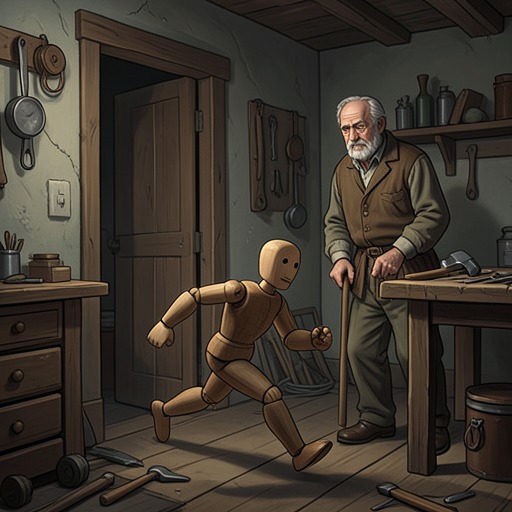
Mastro Antonio gives the piece of wood to his friend Geppetto, who intends to make a Marionette able to dance, fence, and turn somersaults. At home, in a small, simply furnished room, Geppetto takes up his tools and cuts and shapes the wood into a puppet, naming him Pinocchio. The intended performer is thus formed through a craftsperson’s work, but the lively wood makes the result more than a controllable figure. The story introduces Pinocchio through this tension: he is made for performance by another, yet his first pranks announce a will that will repeatedly carry him beyond the role planned for him.
Repeated Lessons and Their Costs
Pinocchio’s confidence repeatedly outruns his judgment. After ignoring the Talking Cricket’s advice, he dismisses the warning about Assassins as a story parents invent to frighten children who run away at night. He imagines confronting them boldly and assumes that, if they do not retreat, he can simply run. The danger arrives before he can carry the boast any further: he hears a rustle in the leaves behind him. The contrast between his easy plan and the immediate threat makes his refusal to listen more than a fault of temperament; it leaves him unprepared for what follows.
Illness turns resistance into another bodily lesson. Pinocchio eagerly eats sugar but refuses the medicine offered by the Fairy. Only when the undertakers come for him does he drink it; he then feels better. Afterward, he tells a lie, and his nose grows longer and longer. The sequence joins two consequences without making them identical: fear finally overcomes his refusal of treatment, while the visible growth of his nose makes dishonesty impossible to keep hidden. In both cases, what he does is registered on his body.
The injury of his schoolmate Eugene brings a sharper recognition of how badly he has judged his companions. When the other boys run away, Pinocchio stays beside the pale, apparently lifeless Eugene, wets his handkerchief in the sea, and bathes the boy’s head. Sobbing, he insists that he did not strike him, fears returning to his mother, and admits that he should have gone to school and should not have listened to the boys. He also recognizes a stubborn pattern: he hears warnings but does as he wishes, then suffers for it. His remorse does not undo the harm or remove his fear; while he is still calling to Eugene and lamenting what will become of him, two Carabineers approach.
Performance, Discipline, and the Changing Body
The Marionette Theater briefly seems to offer Pinocchio a place among his own kind. When the Marionettes recognize him as their brother, they greet him with loud cheers and interrupt the performance to carry him around the stage in triumph. Their welcome is exuberant, but the scene turns abruptly when the Director, Fire Eater, appears. His beard reaches from chin to feet, his mouth is compared to an oven, and his eyes glow like red coals; in his huge hands he brandishes a whip twisted from green snakes and black cats’ tails. The frightened company falls silent. Pinocchio’s arrival has disrupted the show, and the same stage that made him an object of celebration now exposes him to the Director’s threatening authority.
Later, Pinocchio’s body is subjected to a different kind of public performance. After the five months of play that follow his friendship with Lamp-Wick, his ears begin to resemble a donkey’s and he changes into a donkey himself. His master trains him to jump, bow, dance a waltz and polka, and stand on his head, intending to earn money from his acts. Pinocchio has to learn the routines whether he likes them or not; the training takes three months and many lashings before his master declares him ready. The spectacle advertises him as the famous donkey called Pinocchio, turning a transformation born of his choices into a commercial attraction.
At the performance, Pinocchio falls as if dead and rises to applause. Then he sees a woman in a box wearing a gold chain with a medallion bearing the picture of a Marionette. He recognizes the image as himself and the woman as The Fairy with Azure Hair. The recognition gives the scene an intimate counterpoint to the public spectacle: the trained animal on display is still connected, in his own understanding, to the puppet he had been and to the Fairy who has cared for him. His body continues to change, but the medallion makes his earlier identity visible even in the midst of that change.
Reunion, Responsibility, and Transformation
After parting from the Tunny, Pinocchio follows a faint light through the darkness inside the Shark. It leads to a little table set for dinner, lit by a candle stuck in a glass bottle, where an old man sits eating live fish. Pinocchio recognizes Geppetto and, overcome with joy, can scarcely speak before throwing his arms around his father’s neck. Their reunion reverses the long separation in a single embrace: the son who once ran from home now finds the parent he feared he had lost, trapped with him inside the Shark.
The reunion immediately becomes a test of practical courage. Pinocchio tells Geppetto that there is no time to lose and proposes that they escape through the Shark’s mouth and dive into the sea. Rather than waiting passively for rescue, he takes responsibility for finding a way out with his father. The plan marks a change in the direction of his initiative: earlier confidence often dismissed danger, but now his effort is directed toward their shared survival.
Once they are safe, Pinocchio turns care into sustained work. For more than five months, he rises at dawn and goes to the farm to draw water; each day he earns a glass of warm milk for Geppetto, whose strength gradually returns. He also learns to make reed baskets and sells them so the two can keep from starving. His care takes material form as well: he builds a strong, comfortable rolling chair to take his father out on bright days. These are repeated tasks, not a single generous gesture, and their consequence is both practical support and Geppetto’s improving health.
Pinocchio continues to educate himself alongside his labor. In the evenings he studies by lamplight with a secondhand book missing some pages. He makes a writing point by whittling the end of a long stick and uses blackberry or cherry juice in place of ink. His diligence brings progress in both work and study, and he saves fifty pennies, intending to buy a new suit. The contrast with the boy who once sold his schoolbook for a show is concrete: learning now belongs to a routine he maintains, while his earnings are used to keep his father comfortable as well as to prepare for himself.
That night, Pinocchio dreams that The Fairy with Azure Hair praises his care for his old and sick parent and forgives his former mischief. On waking, he discovers that he is no longer a wooden Marionette but a real, living boy. The change is accompanied by a beautifully furnished room and a new suit, hat, and pair of shoes; a small leather purse contains the fifty pennies, returned by The Fairy with Azure Hair with thanks for his kind heart. His transformation therefore follows a sustained change in conduct—work, study, and care for Geppetto—and the ending makes that change visible in both his human body and the life he has helped provide for his father.